
Creating a vision board can look simple from the outside. You choose images, words, colors, and quotes that represent the life you want, arrange them in a way that feels inspiring, and place the board somewhere you can see it. But for many women, the difficult part comes before any of that: deciding what they actually want.
When life has been shaped by responsibilities, routines, other people’s needs, or expectations you have carried for years, your own desires can become harder to recognize. You may know what you should be doing next without feeling certain about what you want next. That is why starting with vision board intentions can make the process more meaningful.
Instead of treating your board as a collection of attractive goals, you can use it as a way to clarify what matters to you now. Your vision board intentions give the images a purpose and help you create something that reflects your own direction rather than someone else’s idea of a successful life.
Before You Choose Images, Ask What Matters Now
A vision board does not need to begin with a list of achievements. It can begin with a quieter question: What matters to me in this season of my life?
That question can be easier to answer than “What do I want?” because it does not ask you to define your entire future. It brings your attention back to the present. Maybe you want more calm in your days, more creative space, stronger relationships, healthier boundaries, financial stability, meaningful work, or simply more time to feel like yourself again.
Your priorities are also allowed to change. Something that mattered deeply to you five years ago may no longer fit the person you are becoming. Creating vision board intentions gives you permission to acknowledge that change instead of forcing yourself to keep pursuing goals that no longer feel relevant.
If you have been feeling disconnected from yourself, this can also be a useful moment to reconsider your relationship with your own needs. The 12-week self-love journey explores that process through reflection, self-compassion, confidence, and healthier boundaries, and it can complement the work you are beginning here.
The Difference Between Goals and Vision Board Intentions
Goals and intentions can work together, but they are not exactly the same. A goal usually describes an outcome you want to reach, while an intention describes the direction, value, or quality you want to bring into your life while moving toward that outcome.
For example, finding a new job is a goal. Creating a work life that feels more aligned with your strengths and priorities is an intention. Saving a specific amount of money is a goal, while building greater financial stability and making more intentional choices with your resources is an intention.
This distinction matters because you may not always know exactly what the final result should look like. You may know you want your life to feel calmer without knowing which habit will create that calm. You may know you want more meaningful work without knowing which position, company, or project will ultimately be right for you.
Vision board intentions give you room to move without requiring complete certainty. They help you choose a direction while remaining open to possibilities you may not have considered yet.
Notice What You Want Versus What You Think You Should Want
Sometimes the goals that appear first are not really yours. They may come from family expectations, social media, cultural ideas about success, or a version of yourself you once believed you needed to become.
You might think your vision board should include a bigger home, a more impressive career, a particular body, constant productivity, or a perfectly organized life because those images are easy to recognize as symbols of success. But if an image does not connect with something genuinely meaningful to you, it can create pressure instead of motivation.
Pay attention when the word should appears in your thinking. You may notice thoughts such as, “I should want this by now,” “I should be further ahead,” or “I should already know which direction to choose.” Those thoughts can reveal moments when outside expectations are becoming louder than your own preferences.
If uncertainty makes you afraid to choose the wrong direction, Fear of Making the Wrong Decision? Start Here can help you distinguish thoughtful decision-making from the kind of second-guessing that keeps you stuck.
The purpose of this reflection is not to reject every goal influenced by the world around you. It is simply to notice whether the life you are imagining feels meaningful to you when no one else is watching.
Use Feelings as Clues to Clarify Your Vision
When people think about a vision board, they often focus first on visible outcomes: a destination, a home, a career milestone, a relationship, or a creative project. Those things can absolutely belong on your board, but feelings can help you understand why they matter.
Ask yourself how you want your everyday life to feel. Your answer might include words such as peaceful, connected, curious, confident, secure, creative, energized, or spacious. Then go one step further and consider what each of those words means in practical terms for you.
For one person, freedom might mean traveling more. For another, it might mean reducing financial obligations. Someone else may associate freedom with being able to say no without feeling guilty. The same word can represent very different lives because its meaning comes from the person choosing it.
Your feelings do not need to become the entire plan. Instead, use them as clues. They can point toward needs, values, and priorities that you may not have been able to name clearly before.
Turn Your Vision Board Intentions Into Meaningful Images
Once your intentions become clearer, choosing images becomes easier because you are no longer asking only whether something looks beautiful. You are asking what the image represents to you.
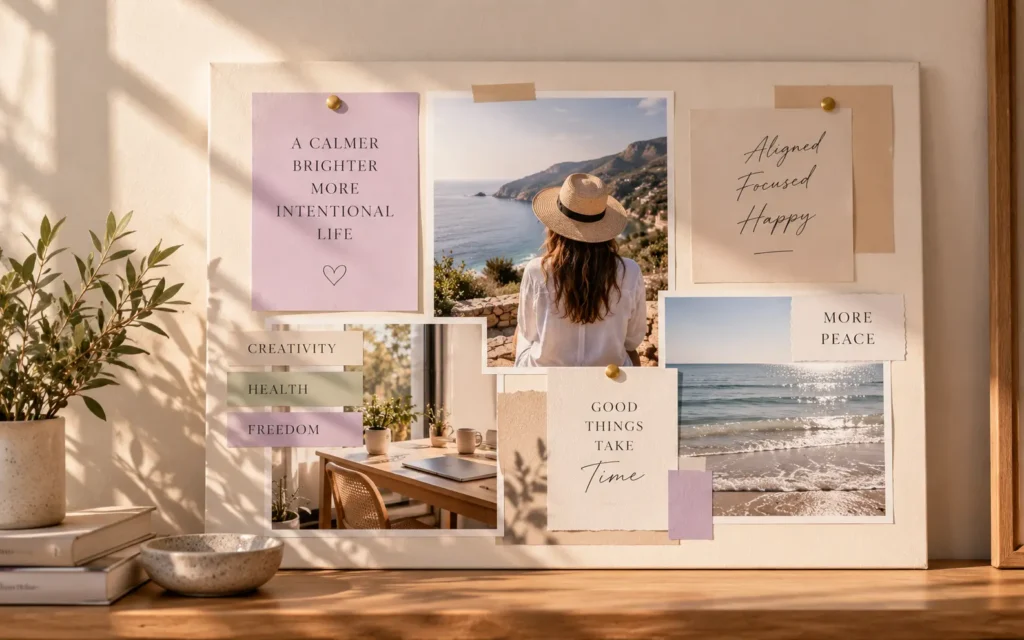
A photograph of a quiet room might symbolize rest, privacy, or a home that feels safe. A path through the mountains could represent exploration, courage, or independence. A desk beside a window might represent meaningful work, creative freedom, or a slower professional rhythm.
The personal meaning matters more than the literal image. Two women could place exactly the same photograph on their vision boards for completely different reasons, and both choices could be meaningful.
Words can work in the same way. A word such as calm, trust, connection, freedom, stability, or create can become a visual reminder of how you want to approach your life. A short phrase may also represent something you are learning to practice, such as protecting your energy, making room for joy, or trusting yourself before immediately asking someone else what they think.
This is what transforms a collection of pictures into a personal vision. The image itself is only the surface. Your intention is what gives it meaning.
Create a Vision Board That Supports You Instead of Pressuring You
A vision board should not become a visual inventory of everything you believe is missing from your life. If looking at your board consistently makes you feel behind, inadequate, or dissatisfied with the present, it is worth reconsidering what you have chosen to place on it.
Try balancing future goals with reminders of what you already value. Your board can include experiences you want to create and qualities you want to strengthen, but it can also represent things you want to protect: your peace, your relationships, your creativity, your health, your time, or the routines that help you feel grounded.
This becomes especially important when your vision board intentions involve other people. You can create space for love and connection without making your well-being depend entirely on someone else behaving a particular way. You can also acknowledge that protecting what matters sometimes requires clearer limits.
If boundaries are part of what you want to strengthen, How to Set Healthy Boundaries Without Feeling Guilty explores how to recognize your limits, communicate your needs, and protect your time and emotional well-being without treating guilt as proof that you are doing something wrong.
A supportive vision board should feel like an invitation rather than a demand. It can remind you where you want to place your attention without turning every image into another obligation you have to complete.
Connect Your Vision Board Intentions With Small Actions
A vision board becomes more useful when it begins influencing what you do after you create it. You do not need a detailed plan for every photograph or word on the board, but connecting your most important intentions with one realistic action can help move them beyond reflection.
If your intention is greater connection, your next step might be contacting someone you miss. If you want more creativity, you could protect one hour each week for a project that belongs only to you. If financial stability appears on your board, your first action might be reviewing one recurring expense or choosing a realistic amount to begin saving.
If one of your vision board intentions is greater confidence, you might practice making one low-risk decision without immediately asking someone else to validate it. If you want more rest, you might begin by creating one evening each week with fewer obligations instead of waiting for an ideal future in which you suddenly have more free time.
These actions do not need to transform your life overnight. Their purpose is simply to give your intentions somewhere to go. Your vision board keeps the direction visible, while your everyday choices gradually bring that direction into your real life.
Reflection Questions for Clearer Vision Board Intentions
Before collecting images, give yourself a little time to write. You do not need dozens of prompts or perfectly developed answers. A few thoughtful questions can reveal themes that are already present beneath the noise of everyday life.
Start by considering what you want more of in your daily life and what has been taking more energy than you want to give it. Think about how you want your days to feel, what you are ready to make less important, and what part of yourself you would like to reconnect with.
Then consider what you would explore if you were less afraid of making the wrong choice. Which relationships deserve more of your attention? What boundary might protect something important to you? What would make the next season of your life feel meaningful, even if the result could not be measured or displayed to anyone else?
You can also ask yourself what you want to create more space for, what you want to feel more often, and what deserves more intentional attention. These questions help move your vision board intentions away from vague wishes and toward something more personal.
One final question can be particularly revealing: If I stopped thinking about what I should want, what would I choose?
You do not need to force an immediate answer. Write for a few minutes, leave the page, and return later if necessary. Often the same ideas begin appearing in several different answers. Those recurring themes can become the foundation of your vision board.
Create Your Vision Board With Intention and Purpose
Once you understand what matters to you, what you want more of, and what direction you want to explore, you can begin translating those ideas into images, words, colors, and visual reminders.
This is where the creative part becomes easier. Instead of beginning with an empty board and trying to invent a future from scratch, you are beginning with meaning. Your vision board intentions have already given you a framework for deciding what belongs and what does not.
If you want guidance for the practical next step, use the free Dreams Fusion resource How to Create a Vision Board With Intention & Purpose. It will help you move from reflection into selecting meaningful images and creating a board around the intentions you have identified.
Your vision board does not need to predict exactly what will happen next. It does not need to contain every goal you will ever have, and it certainly does not need to look like anyone else’s board.
Its purpose is simpler: to help you recognize your direction.
When your vision board intentions come from what genuinely matters to you, the finished board becomes more than something beautiful to look at. It becomes a visual reminder of what you want to protect, explore, create, and move toward, one thoughtful choice at a time.
VISION BOARD GUIDE
VISION BOARD GUIDE FOR BEGINNERS
Ready to turn your intentions into something you can see? This beginner-friendly guide helps you clarify what matters, choose meaningful images, and create a vision board that reflects your goals, values, and personal direction.