
Setting a boundary can sound simple.
Say no.
Ask for what you need.
Protect your time.
Walk away when something does not feel right.
But knowing that you need a boundary and actually setting one can feel like two completely different things.
For many women, the difficult part is not recognizing that something needs to change. It is what happens afterward.
The guilt.
The second-guessing.
The urge to explain yourself.
The fear that someone will be disappointed, upset, or think differently of you.
Learning to set healthy boundaries without guilt does not mean you will never feel uncomfortable. It means learning that discomfort does not automatically mean you are doing something wrong.
Sometimes it means you are finally making space for yourself.
What Are Healthy Boundaries?
Healthy boundaries are the limits you create around your time, energy, emotions, responsibilities, relationships, and personal space.
They help define what feels acceptable to you and what does not.
A boundary might sound like:
- “I can’t take that on right now.”
- “I need some time before I answer.”
- “I’m not comfortable discussing that.”
- “I can help for an hour, but I can’t stay all day.”
- “I need some quiet time tonight.”
- “That doesn’t work for me.”
Boundaries are not walls designed to keep everyone away.
They are a way of creating enough clarity and safety for relationships, responsibilities, and your own well-being to coexist.
When your boundaries are unclear, it can become easy to say yes automatically, take on too much, ignore your needs, or resent commitments you never truly wanted to make.
Why Do Boundaries Create So Much Guilt?
Guilt often appears when your new behavior conflicts with an old expectation.
Maybe you learned that being helpful meant always being available.
Maybe saying no was interpreted as selfish.
Maybe keeping the peace felt safer than expressing what you actually wanted.
Maybe you became the person everyone could depend on, even when being dependable came at your own expense.
When you begin setting boundaries, you are not only changing what you do.
You may also be challenging beliefs you have carried for years.
That is why a simple sentence like “I can’t do that today” can sometimes feel emotionally much bigger than it sounds.
Guilt Does Not Always Mean You Did Something Wrong
This distinction is important.
Guilt can be useful when we have genuinely acted against our values or hurt someone.
But guilt can also appear simply because we are doing something unfamiliar.
You may feel guilty because:
- someone is disappointed,
- you are prioritizing your own needs,
- you are no longer immediately available,
- you are changing an established pattern,
- you are asking another person to take responsibility for something you usually handle,
- or you are choosing rest instead of productivity.
The presence of guilt does not automatically make the boundary inappropriate.
Sometimes guilt is simply the emotional discomfort of doing something differently.

Signs You May Need a Boundary
You do not always need a dramatic conflict to justify setting a boundary.
Often, the need shows up in quieter ways.
You might notice:
- resentment after agreeing to something,
- exhaustion from being constantly available,
- anxiety when certain people contact you,
- frustration because your time never feels like your own,
- repeatedly saying yes and wishing you had said no,
- feeling responsible for other people’s emotions,
- avoiding someone because direct communication feels uncomfortable,
- or neglecting your own priorities because other people’s needs always come first.
These feelings do not automatically tell you what boundary to set.
But they can be useful information.
Instead of immediately judging yourself for feeling irritated, tired, or overwhelmed, try becoming curious.
Ask:
What is this feeling trying to tell me about what I need?
Start by Identifying What You Need
Boundaries become easier to communicate when you understand what you are protecting.
Before deciding what to say to someone else, pause and ask yourself:
- What feels uncomfortable here?
- What am I agreeing to that I do not actually want?
- What am I afraid will happen if I say no?
- What would make this situation feel more manageable?
- What part of this is actually my responsibility?
- What do I need more of right now?
- What do I need less of?
You do not have to justify every need before allowing yourself to recognize it.
Sometimes you simply need more time.
More rest.
More privacy.
More space.
More clarity.
If identifying what you need feels difficult, these journal prompts to reconnect with yourself can help you slow down, listen more closely, and notice what may have been asking for your attention.
How to Practice Healthy Boundaries Without Guilt
A boundary does not need to be a long explanation.
In fact, the more uncomfortable we feel, the more tempting it can be to over-explain.
We start building a case for why our needs should be considered valid.
But a clear boundary can often be much simpler.
Instead of:
“I am so sorry, I know I usually help and I really don’t want you to think I don’t care, but I’ve had such a busy week and I have so many things going on…”
You might simply say:
“I can’t help with that this weekend.”
Instead of explaining every reason you need space:
“I need some time to think before we continue this conversation.”
Instead of agreeing because you feel pressured:
“Let me check my schedule and get back to you.”
Clarity can feel uncomfortable at first.
But clarity is often kinder than agreeing reluctantly and becoming resentful later.
You Are Allowed to Pause Before Saying Yes
One of the simplest boundaries you can practice is creating space between a request and your answer.
If you tend to say yes automatically, try replacing an immediate answer with:
“Let me think about it.”
or:
“Let me check what I already have planned.”
That small pause gives you time to ask yourself:
Do I actually want to do this?
Do I have the capacity?
Am I saying yes because I want to, or because I am afraid to say no?
You do not have to make every decision in the moment.
Someone Else’s Disappointment Is Not Always Your Responsibility
This can be one of the hardest parts of setting boundaries.
You can communicate respectfully and someone may still feel disappointed.
They may prefer your old pattern.
They may wish you had said yes.
They may not understand immediately.
That does not necessarily mean your boundary was unkind.
Part of healthy boundary setting is learning to distinguish between:
being responsible for how you communicate
and
being responsible for another person’s emotional reaction.
You can be thoughtful.
You can be respectful.
You can listen.
But you cannot always prevent disappointment.
Boundaries and Self-Love Are Closely Connected
Self-love is not only about how you feel about yourself.
It also appears in how you treat yourself.
If you repeatedly ignore your limits, minimize your needs, or abandon your priorities to avoid disappointing others, your actions may be sending yourself an important message:
Everyone else’s needs matter more than mine.
Healthy boundaries begin challenging that message.
They say:
My time matters too.
My energy has limits.
My feelings deserve consideration.
My needs are allowed to exist alongside someone else’s.
That does not make you selfish.
It makes your relationship with yourself part of the equation.
If gratitude feels like a natural next step in your journey, explore how gratitude journaling for healing can complement your reconnection practice.
Journal Prompts for Setting Healthy Boundaries
Journaling can help you notice patterns before trying to change them.
You might explore:
- Where in my life do I most often say yes when I want to say no?
- What am I afraid will happen if I set a boundary?
- Whose disappointment feels hardest for me to tolerate?
- What situations leave me feeling resentful or emotionally drained?
- What boundary would make one area of my life feel more manageable?
- Where am I taking responsibility for something that does not belong entirely to me?
- What would I say if I did not feel the need to over-explain myself?
- What does respecting my own time look like?
- What is one boundary I already maintain well?
- What would change if I trusted myself to decide what is right for me?
You do not need to answer them all.
Choose the question that creates the strongest reaction.
That may be the one worth exploring.
Practice One Small Boundary at a Time
You do not have to transform every relationship in your life this week.
Start somewhere manageable.
Maybe your boundary is:
- waiting before responding to a request,
- not checking messages during a certain part of the evening,
- declining one commitment,
- asking someone else to share a responsibility,
- ending a conversation when you are too overwhelmed to continue,
- or protecting one hour for something that matters to you.
Small boundaries still count.
Every time you practice honoring a limit, you learn something about what you need and how you want to be treated.
What If You Still Feel Guilty?
You might.
Especially in the beginning.
Instead of waiting for the guilt to disappear before maintaining your boundary, try asking yourself:
Was I disrespectful, or am I simply uncomfortable?
Did I act against my values, or did I make a choice someone else did not prefer?
Am I actually responsible for fixing this person’s disappointment?
Would I expect someone I love to ignore their own needs in this situation?
Self-compassion becomes especially important here.
You can feel guilty and still choose not to abandon yourself.
The goal is not to become unaffected by other people’s feelings.
The goal is to stop treating every uncomfortable feeling as proof that your boundary was wrong.
Healthy Boundaries Take Practice
You may communicate a boundary perfectly one day and struggle the next.
You may say no and then spend an hour questioning yourself.
You may realize after a conversation that you agreed to something you did not want.
That does not mean you failed.
Learning to practice healthy boundaries without guilt takes time.
So is self-compassion.
So is confidence.
Each time you notice what you need, pause before responding, communicate more clearly, or choose not to over-explain, you are practicing a different relationship with yourself.
One where your needs do not have to disappear in order for you to care about other people.
Go Deeper With Your Self-Love Practice
Healthy boundaries are one part of building a more supportive relationship with yourself.
If you want to explore self-compassion, confidence, and boundaries through a more structured practice, Getting to the Root of Loving Yourself offers a guided 12-week journey designed to help you slow down, reflect, and work through these areas one step at a time.
Learning to love yourself is not only about feeling differently.
Sometimes it begins with choosing differently.
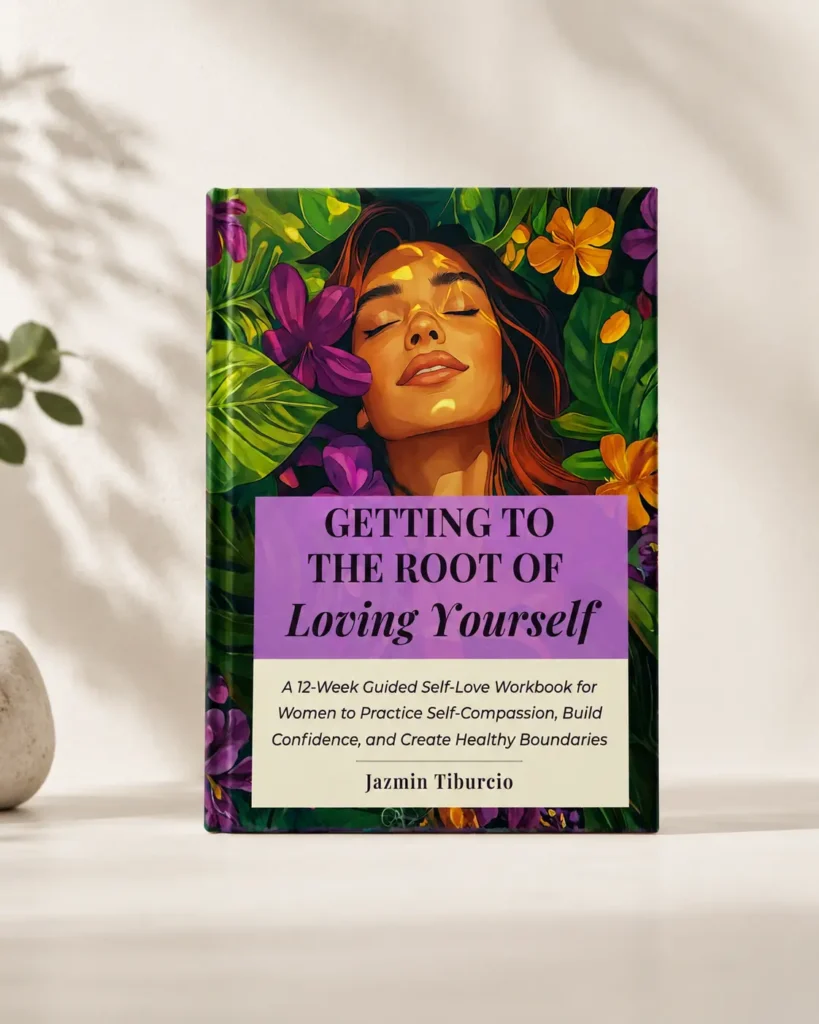
GUIDED SELF-LOVE WORKBOOK
Getting to the Root of Loving Yourself
A 12-week guided self-love workbook for women designed to help you practice self-compassion, build confidence, create healthy boundaries, and develop a more supportive relationship with yourself.