
Self-love is often talked about as if it were a feeling you should simply have.
But for many women, loving yourself does not begin with suddenly feeling confident, positive, or completely comfortable with who you are. It begins much more quietly.
It can begin by noticing how you speak to yourself.
By listening to what you need.
By questioning the expectations you have been carrying.
By allowing yourself to say no without immediately explaining why.
And sometimes, by giving yourself enough time to practice these things more than once.
That is what makes a 12-week self-love journey so meaningful. Instead of expecting an immediate transformation, you give yourself space to build a different relationship with yourself, one small reflection at a time.
If you have been feeling disconnected from yourself lately, you may also find these journal prompts to reconnect with yourself helpful as a gentle place to begin.
Why Take 12 Weeks to Practice Self-Love?
Self-love is not something you complete after reading the right quote or writing in your journal once.
It is a relationship.
And like any relationship, it is shaped by repeated actions, thoughts, choices, and boundaries.
A 12-week journey gives you enough time to slow down and notice patterns that are easy to miss when life feels busy.
You may begin to recognize:
- how quickly you criticize yourself after making a mistake,
- where you regularly ignore your own needs,
- which situations make you doubt yourself,
- when you say yes even though you want to say no,
- what helps you feel more grounded and confident,
- and what you may need to release.
You do not have to solve everything you notice.
Awareness itself is an important beginning.
The goal is not to become a completely different person in twelve weeks. It is to become more intentional about the relationship you already have with yourself.
Self-Love Is More Than Positive Thinking
Self-love is sometimes reduced to affirmations, confidence, or feeling good about yourself.
Those things can be part of it, but a deeper self-love practice also asks more meaningful questions.
How do you respond to yourself when life is difficult?
This is where self-compassion becomes important.
Self-compassion does not mean pretending that everything is fine. It means learning to meet your mistakes, disappointments, fears, and difficult moments without automatically turning against yourself.
Do you trust yourself enough to take the next step?
Confidence does not always look bold.
Sometimes confidence means making one decision without asking everyone else if it is the right one.
Sometimes it means recognizing that you have already survived situations you once thought you could not handle.
Sometimes it simply means keeping a small promise you made to yourself.
Do your boundaries reflect what you say matters to you?
Healthy boundaries are also part of self-love.
Your time matters.
Your energy matters.
Your emotional well-being matters.
Learning to recognize your limits, communicate your needs, and protect space for yourself can be uncomfortable, especially if you are used to putting other people’s expectations first.
But self-love becomes much more tangible when it begins influencing the choices you make.

A Simple Way to Think About a 12-Week Self-Love Journey
There is no single correct way to practice self-love.
However, dividing the journey into smaller stages can make the process feel less overwhelming.
Weeks 1-4: Notice
The first few weeks can be about paying attention.
Not fixing. Not judging. Simply noticing.
Week 1: Notice your inner dialogue
Listen to the words you use when talking to yourself.
Would you use the same language with someone you love?
Week 2: Notice your needs
Ask yourself what you have been needing emotionally, mentally, creatively, or practically.
Needs do not become less valid because they are inconvenient.
Week 3: Practice self-compassion
Notice what happens when you make a mistake or feel disappointed in yourself.
Try replacing immediate criticism with curiosity.
Week 4: Question old expectations
Consider the standards you have been trying to meet.
Are they actually yours?
Do they still belong in the life you are creating?
If questioning old expectations leaves you wondering who you are beneath them, these journal prompts for when you feel lost can help you explore that feeling with more clarity.
Weeks 5-8: Practice
Awareness creates the opportunity to make different choices.
The next stage can focus on small actions.
Week 5: Look for evidence of your strength
Confidence is easier to build when you stop ignoring what you have already accomplished.
Write down moments when you adapted, learned, tried again, spoke up, solved a problem, or continued despite uncertainty.
Week 6: Keep one small promise to yourself
Choose something realistic.
Ten quiet minutes.
One journal page.
Going to bed earlier.
Finishing something you have been postponing.
Confidence grows when you begin experiencing yourself as someone you can rely on.
Week 7: Notice where you need a boundary
Where are you regularly feeling resentment, exhaustion, pressure, or discomfort?
Sometimes those feelings are information.
Week 8: Allow boundaries to feel uncomfortable
Setting a boundary does not always feel empowering immediately.
You may feel guilty.
You may worry that someone will be disappointed.
You may want to explain yourself repeatedly.
Discomfort does not automatically mean your boundary is wrong.
Weeks 9-12: Strengthen
The final part of the journey is not about reaching a perfect version of yourself.
It is about recognizing what you want to continue practicing.
Week 9: Protect what helps you feel grounded
Identify routines, people, environments, and practices that support your well-being.
Give them intentional space.
Week 10: Celebrate progress you usually overlook
Progress is not limited to dramatic achievements.
Maybe you spoke more kindly to yourself.
Maybe you paused before saying yes.
Maybe you asked for help.
Maybe you stopped minimizing something you were proud of.
Let those moments count.
Week 11: Revisit what you have learned
Read an older journal entry.
Notice what feels different.
Notice what still feels difficult.
Both are useful information.
Week 12: Decide what you want to carry forward
A 12-week journey can end without your self-love practice ending.
Ask yourself:
What do I want to continue?
What do I need less of?
What boundary deserves more protection?
What have I learned about myself?
What would it look like to keep choosing myself in small, realistic ways?
Journal Prompts for Your Self-Love Journey
You do not need dozens of questions every time you sit down to journal.
Sometimes one honest question is enough.
Try beginning with one of these:
- What do I need from myself today?
- Where am I being harder on myself than I would be with someone I love?
- What is something I handled better than I give myself credit for?
- Where in my life am I saying yes when I want to say no?
- What would supporting myself look like in this situation?
- What is one small promise I can realistically keep to myself this week?
- What am I learning about the way I speak to myself?
- Which expectations am I ready to question?
- What makes me feel more like myself?
- What do I want my relationship with myself to feel like?
You can return to the same question more than once.
Your answer may change as you do.
What If You Miss a Week?
Then you continue.
A self-love practice should not become another reason to criticize yourself.
You do not need perfect attendance.
You do not need beautifully written journal pages.
You do not need to feel motivated every day.
If you stop for a few days or even a few weeks, you can return to the next page when you are ready.
The purpose is not perfection.
The purpose is practice.
How to Make the Journey Feel Sustainable
Keep your self-love practice simple enough that it can exist inside your real life.
You might journal for ten minutes once or twice a week.
You might choose one question and think about it throughout the day.
You might write only a few sentences.
You might spend an entire week noticing one pattern without trying to change it yet.
Small, consistent moments of attention can often reveal more than forcing yourself through a complicated routine.
Let your practice support you rather than become another obligation.
Go Deeper With a Guided 12-Week Practice
If you would like more structure for this journey, Getting to the Root of Loving Yourself was created as a guided 12-week self-love workbook for women who want to explore their relationship with themselves more intentionally.
The workbook focuses on practicing self-compassion, building confidence, and creating healthy boundaries, with guided space to reflect and work through the process one step at a time.
You do not have to become someone new. You can begin by learning how to support the person you already are.
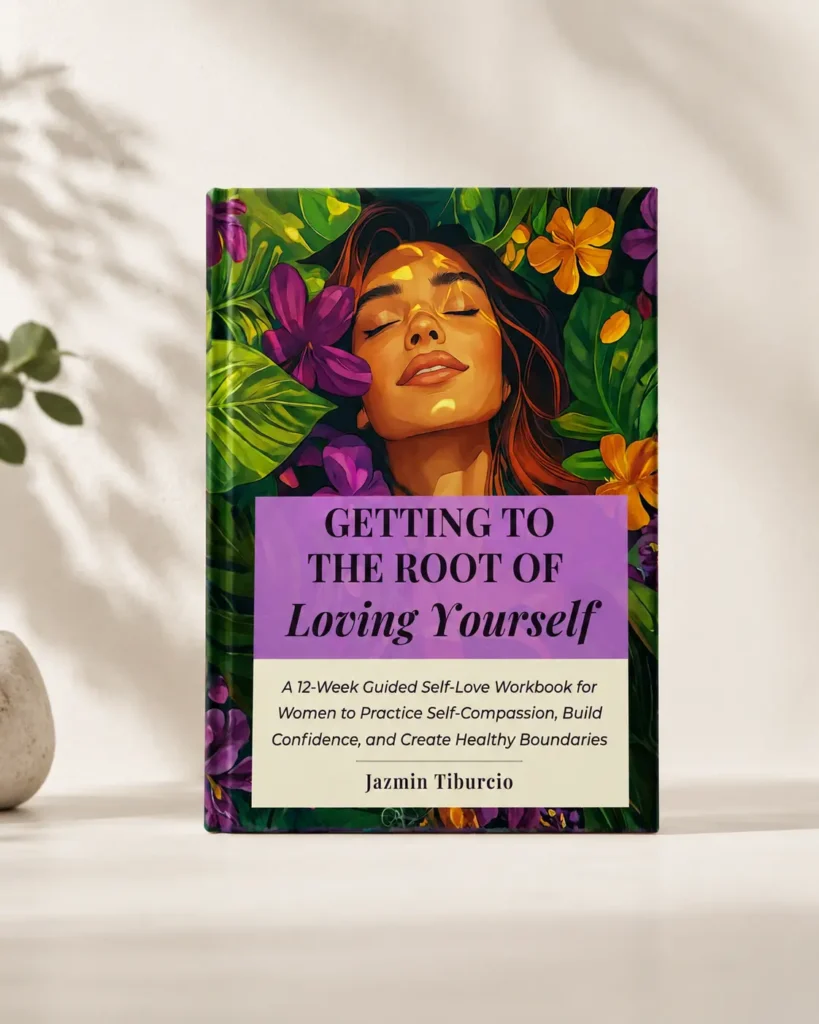
GUIDED SELF-LOVE WORKBOOK
Getting to the Root of Loving Yourself
A 12-week guided self-love workbook for women designed to help you practice self-compassion, build confidence, create healthy boundaries, and develop a more supportive relationship with yourself.